
Jemaa el-Fnaa
This track came together on an art retreat at Peacock Pavilions just outside Marrakech. Tucked away in a rural community just beyond the city, it’s a place that encourages creativity and focus without ever feeling cut off — olive groves, lush gardens, and long sightlines to the Atlas Mountains, but just a few minutes from the treacherous RN9 into the city. It's a great place to get stuff done at your own pace.
Christine was there for a painting workshop. The plan was that, for the first few days, the artists would head into the city — the souks, the alleys, the old town — taking photos, sketching, absorbing colour and texture, then returning to translate that material into canvases. I thought that while they painted, I'd catch up on my music.
As in Umbria, my intention was pragmatic: take a couple of half-finished tracks with me and finally close them out. Clean endings, solved problems, boxes ticked. But watching the painters work — the way they gathered raw material first, without knowing exactly what it would become — gradually dismantled that plan. Instead of finishing something old, I started listening to what they were looking at.
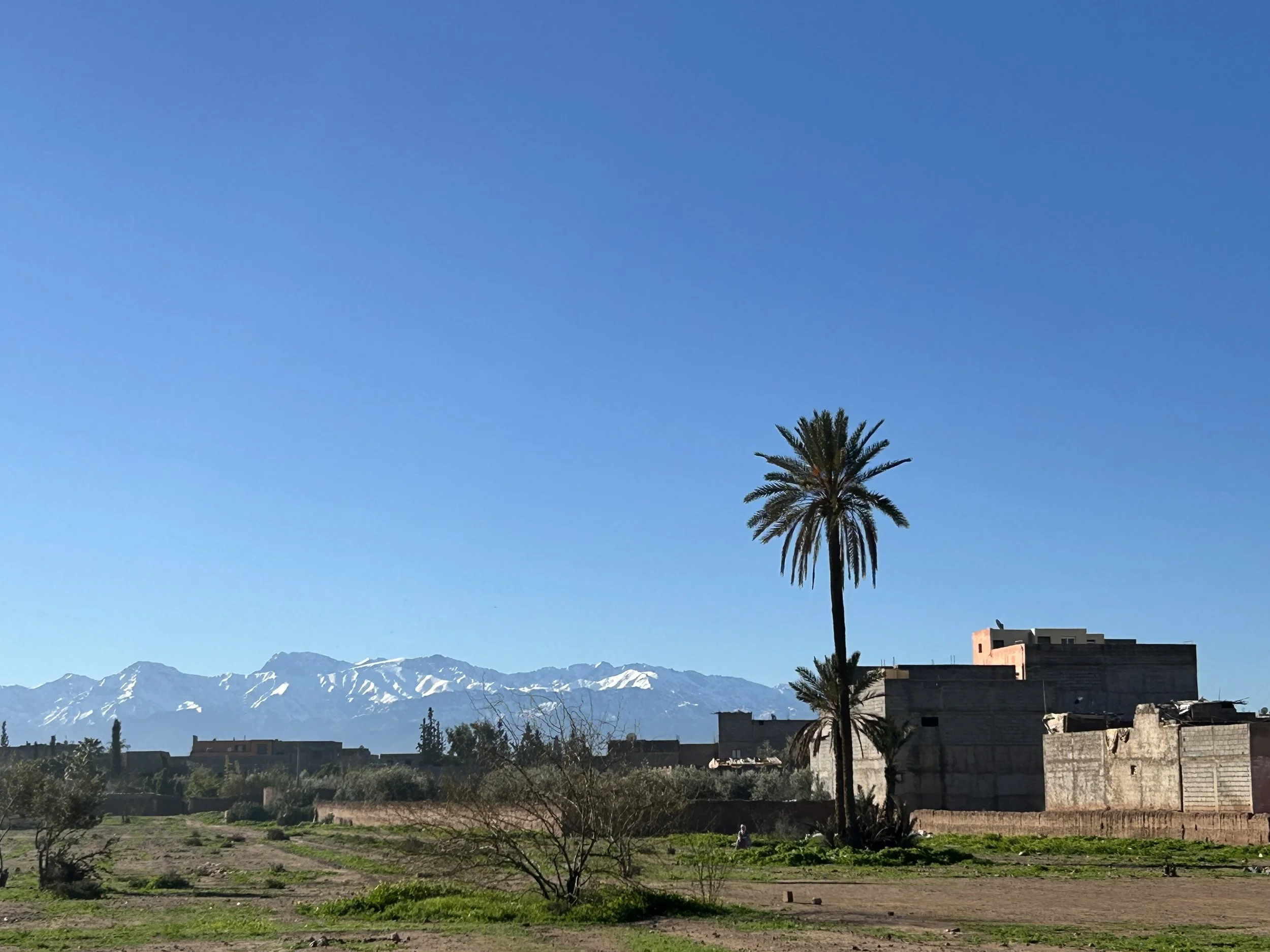
Marrakech in February is a different city. Still vibrant, but slightly less crowded than later in the year; a little more space between sounds. I began recording the city on my iPhone: textures, fragments and soundscapes – often just a few seconds at a time. A vendor’s call bouncing down a narrow alley. Tools striking metal. Footsteps, animals, wheels on cobbles. The track that emerged became a kind of sonic postcard — not a documentary, but a memory of place, filtered through the process of building a tune.
The foundation of the track is a drone pad built in Granulator III from a recording of the snake charmers in Jemaa el-Fnaa. Time stretched and pitch-locked, with grain size automated slowly, it became something darker and more ambiguous than the source — a dense, low, uneasy pad that contrasts nicely with the spare arrangement elsewhere. Filtering and gentle random spray modulation kept it alive without ever drawing focus.
Percussion and overheads came almost entirely from recordings of artisans at work: shoemakers, metalworkers, wood carvers. These were sliced aggressively in Simpler, with micro-loops triggered via MIDI, as well as one-shots created for the hats. Transients were exaggerated or suppressed depending on role — some sounds sharpened into crisp ticks, others smeared into ghosted textures — creating rhythmic interest without relying on recognisable drum timbres.
The leads and both bass parts all originated from a single recording: the wheels of a cart rolling over cobbles in the Medina. Once pitched, morphed and sequenced, this became the most technically challenging element of the track. Heavy filtering and Auto Filter morphing introduced severe phase issues, particularly once the sound was split into melodic and low-end roles.
The solution was surgical rather than corrective:
The signal was split into three frequency bands
Each band was processed independently (filter slopes, envelope movement, saturation)
Align Delay was used to manually time-align phase relationships between bands, rather than relying on linear-phase EQ
Only once coherence was restored were the bands recombined and sent to shared modulation and spatial FX
It was slow work, but the payoff was a bass/lead relationship that felt physical and grounded, without collapsing in mono.
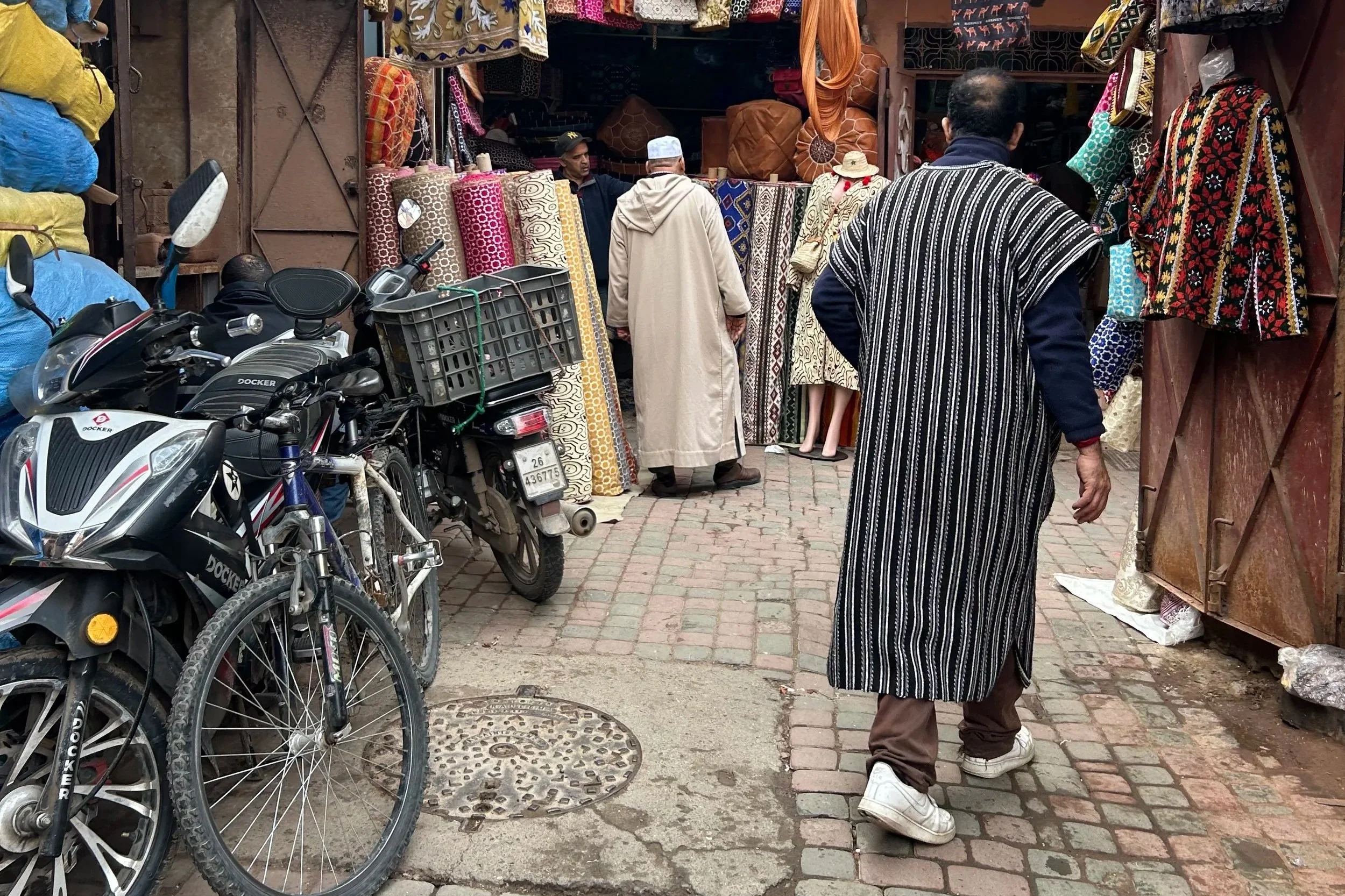
I think the sounds of the street and the main vocals are what truly anchor the track to place. Recordings of vendors calling to one another in the souk were chopped tightly and played chromatically through Simpler, then animated with delays, filters and Autopan. The aim wasn’t intelligibility, but presence — voices as rhythm and contour rather than narrative. Treated this way, they sit somewhere between melody and percussion, constantly moving but never dominant.
Almost everything you hear — aside from the kick — comes from these field recordings. Even the incidental sounds found their way in. A camel’s low growl became a surprisingly powerful impact transition at the opening. A rooster, crowing relentlessly every day while I worked, eventually revealed itself to be perfectly in key. Once noticed, it was impossible not to include, and it now recurs as a quiet, grounding motif.
It was a challenging track to make. Working this way removes a lot of safety nets, and every decision has consequences further down the chain. But it was also deeply rewarding. Letting the environment dictate both source material and structure changed my relationship with the process — and it’s opened the door to a more intentional field-recording phase going forward.
To me, this one feels like the city. Which makes sense, really — the city made it.