
As I often seem to do, I started this piece by trying to get away from the minimalist techno groove I instinctively reach for. There's nothing particularly wrong with that approach. In fact, it's probably where I'm most comfortable. But occasionally I become conscious that I'm solving the same musical problems in slightly different ways, and that seems like a good reason to try something else.
This time I wanted something a little more chilled. Less insistent, less concerned with building tension, and perhaps more interested in what happens between the beats than in the beats themselves.
The starting point was a flight back from Sydney.
Somewhere over the Indian Ocean I opened Ableton Note on my phone and began playing around with a simple melody. I haven't used Note nearly as much as I expected to when it first appeared. There's something about making music on a phone that still feels slightly wrong to me, probably because I've spent so many years associating music production with a decent pair of monitors and an unreasonable number of things to tweak.
But that's rather missing the point.
What's interesting about Note is that it removes almost all the ceremony surrounding the beginning of a track. There's no elaborate template to load, no collection of plugins demanding attention, and very little temptation to spend twenty minutes designing a kick drum before you've actually had a musical idea. You simply capture something before it disappears. At 35,000 feet, with no possibility of retreating into my usual production habits, that turns out to be quite liberating.
The melody was almost embarrassingly simple. But I liked it, and more importantly, it suggested a piece of music that didn't need to become particularly complicated.
The finished track is unusually short for me, at just four minutes, and sits at a relatively leisurely 120 BPM. I've also returned to a conventional four-to-the-floor kick pattern, something I'd been moving away from recently. So in one sense I've ended up back in familiar territory. The difference is that I didn't want the kick, or even the melody, to carry the track. I wanted the interest to emerge from the rhythm and texture surrounding them.
That made the percussion unusually important.
As usual, almost all of it began life as foley rather than conventional drum sounds. Small physical noises, recordings of objects being handled or struck, and other bits of incidental sound were subjected to enough processing that their original identities became largely irrelevant. I've always liked the fact that foley brings a certain amount of imperfection into electronic percussion. Even after quite aggressive processing, traces of the original acoustic behaviour survive. Those traces are often what make the sound interesting.
For this piece I spent a lot of time building subtle variations into those sounds. Not obvious fills or new percussion parts, but small changes in density, timbre and decay. Individual hits change colour. Details appear for a few bars and disappear. The underlying groove remains consistent, but its surface is constantly being rearranged.
Ideally, you become aware that the track feels different from a minute ago without being entirely sure what has changed.
There's another layer to that idea, and it came from the time I spent in Australia.
While I was there I recorded half a dozen different indoor and outdoor spaces. I wasn't particularly interested in capturing events, but rather their acoustic character: background noise, reflections, air and distance. Those recordings are woven into the track at a level where you probably wouldn't consciously identify them. Sometimes they contribute a faint wash of ambience; elsewhere they alter the perceived depth or colour of an existing sound.
I like the idea that a track can change location without the listener necessarily realising that it has moved. Those Australian recordings became another way of introducing structural movement without adding more music.
And adding more music was precisely what I was trying to avoid.
The arrangement is deliberately spare. In fact, a surprisingly large proportion of the production time was spent removing things rather than creating them. Entire channels disappeared. Percussion patterns were simplified. Individual hits were taken out of otherwise successful loops. Parts of stems that initially seemed important turned out to be doing very little beyond occupying space.
There's a tendency, particularly when working in a DAW with almost unlimited tracks and processing power, to equate development with accumulation. If a section needs more energy, add another layer. If the groove feels static, introduce another sound. If the arrangement isn't progressing, automate something.
Sometimes the more interesting answer is subtraction.
And subtraction doesn't necessarily mean muting a channel.
I also spent a lot of time removing frequencies. A sound can occupy far more of an arrangement than its apparent loudness suggests, and sometimes the problem isn't that there are too many parts, but that each part is trying to do too much. Removing the body of a percussion sound, or taking away some of its high-frequency attack, can completely change its relationship with everything around it.
What's interesting is that these decisions affect the rhythm as much as the mix. A sound can become less assertive without becoming quieter. A tiny transient can suddenly seem important simply because something else has been taken away. The arrangement starts to acquire a kind of negative space, where the gaps become as deliberate as the sounds themselves.
I probably spent an unreasonable amount of time working on things that, ideally, nobody will consciously notice.
Of course, all of that restraint makes the kick rather exposed.
For this I returned to PunchBOX 2, which has become one of my absolute go-to tools for designing techno kicks. If you're making electronic music, it's the sort of instrument that really deserves a place in your toolbox. It gives you remarkable control over the body, transient and character of a kick, and can move from something deep and rounded to aggressively distorted and industrial without much effort.
Normally I'd use it to create something with a fairly assertive physical presence. This time I wanted almost the opposite.
The kick needed to be short, dry and slightly dusty. It still had to establish the four-to-the-floor pulse, but I didn't want the enormous, polished low-frequency event that dominates so much contemporary techno. So I deliberately pushed PunchBOX away from its more obvious strengths, reducing the weight and sustain and roughening the sound until it felt a little worn around the edges.
It's a slightly perverse use of a tool capable of producing spectacularly powerful kicks, but that's part of why I like it. The value of a good synthesizer isn't simply that it can produce an impressive sound. It's that it gives you enough control to produce a deliberately unimpressive one, when that's exactly what the music needs.
Here, the kick is less a statement than a reference point. It provides something stable against which all those tiny rhythmic and textural changes can become perceptible.
Looking back, that's probably the central idea behind the whole piece.
The melody is simple. The tempo is unhurried. The arrangement contains relatively few elements. Yet within that limited framework there's quite a lot happening. Foley-derived percussion changes shape and colour, acoustic environments drift almost invisibly between one another, and sounds continually gain or lose small pieces of their character.
None of these processes is particularly dramatic in isolation. Together, though, they create a piece that evolves without needing to announce its evolution.
The visualiser that accompanies the track takes much the same approach. Both the title and theme came to me when I was in Cork recently on a beautiful late autumn Sunday along Winter’s Hill. I wondered how the city should look to an alien randomly auditing the sights.
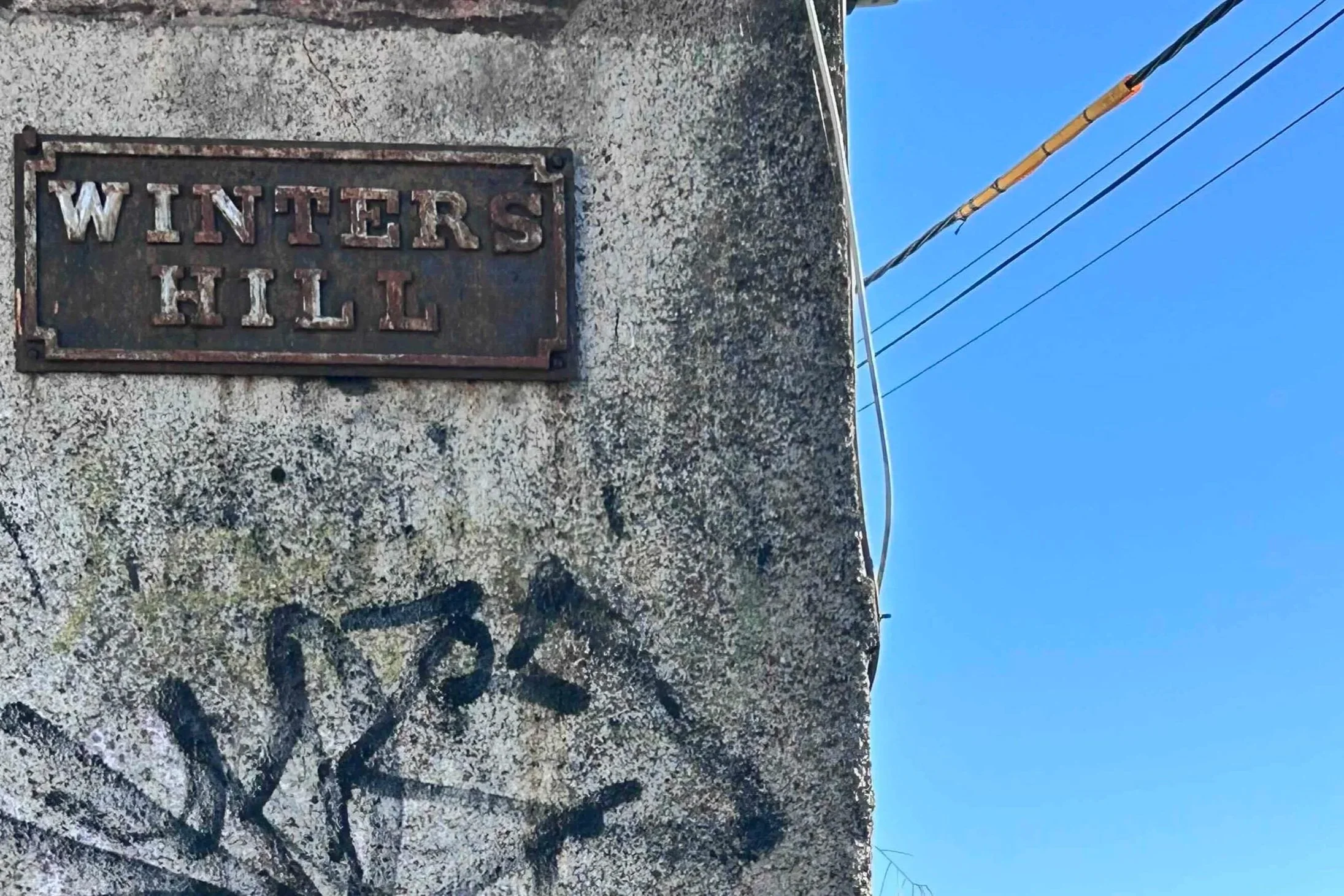
It develops the on-the-fly editing system I've used in previous pieces, where the browser constructs a visual sequence as the music plays rather than simply presenting a finished video. This time, however, I've become less interested in the edit as an obvious event and more interested in the image as an evolving texture.
Rather than relying on dramatic cuts or conspicuous glitches, the visualiser places greater emphasis on changes in density, surface, movement and visual character. Details emerge or recede, images acquire different qualities, and successive moments shift without necessarily producing an identifiable transition.
There's still a system making decisions, and still an element of controlled unpredictability. But increasingly I'm interested in what happens when that machinery stops drawing attention to itself and begins leaning in to the serendipity.